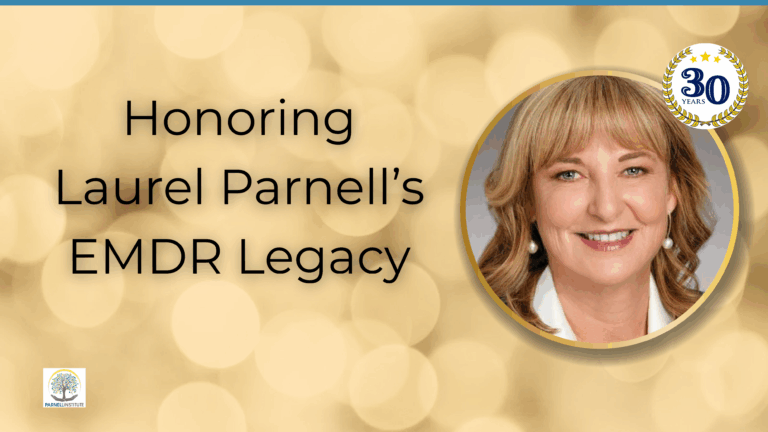
Thirty years is not just a measure of time.
It is time spent sitting with people in their most vulnerable moments. Time spent listening closely to what the nervous system is asking for. Time spent noticing, again and again, what truly helps people heal when trauma lives in the body and nervous system, not just in the story that can be told.
This year marks 30 years of Laurel Parnell teaching EMDR. As the founder of the Parnell Institute and the developer of Attachment-Focused EMDR (AF-EMDR), Laurel has shaped the field in lasting ways, not by insisting on certainty or rigidity, but by staying deeply attentive to human experience. Her work has helped EMDR evolve into a more relational, developmentally informed, and safety-centered approach to trauma healing.
Her influence is felt not only in books and trainings, but in thousands of therapy rooms around the world, where clinicians slow down, prioritize safety, and trust clients’ innate healing intelligence to guide the healing process.
This reflection, drawn from a recent conversation with longtime colleague Elena Felder, LMFT, traces the values, questions, and lived experience that have guided Laurel’s work for three decades.
Before EMDR: The Ground Beneath the Work

Long before EMDR entered her life, Laurel Parnell’s clinical foundation was already rooted in relationship, development, and care.
She began her career working in community clinics throughout the Bay Area, serving children, families, and adults from diverse cultural and linguistic backgrounds, many of them Spanish-speaking and economically marginalized. Her psychodynamic and Jungian training was complemented by a lifelong meditation practice, which quietly informed how she showed up with clients.
She also completed doctoral research on domestic violence, examining why women often return to abusive partners even when financial dependence is no longer a factor. What emerged was not a story of pathology, but a deeper understanding of attachment, loss of self, and relational fusion, and how unsafe relationships can slowly erode a person’s sense of identity.
This early work shaped how Laurel would later approach trauma. Healing, she understood, could not be reduced to insight alone. It required safety, attunement, and respect for the developmental context in which wounds formed.
Discovering EMDR: Seeing Something Shift
Laurel first encountered EMDR in 1991, shortly after its earliest trainings, while attending a meditation retreat in Southern California. At the time, she was skeptical.
“I couldn’t imagine moving my fingers in front of someone’s face,” she recalls. “It didn’t make sense to me in a psychodynamic framework.”
Then she saw it work.
She witnessed people who had been profoundly dysregulated return to a sense of coherence. She experienced firsthand how EMDR could interrupt relentless cognitive looping that had felt impossible to stop.
What struck her most was not just symptom relief, but perspective. People were no longer trapped inside their memories. They could see them.
“That was the moment,” Laurel says. “I saw the before and the after. I signed up for the next training.”
The Early Days of EMDR: Trust, Curiosity, and Discovery
In the early 1990s, EMDR was still taking shape. Trainings were held in hotel ballrooms filled with hundreds of clinicians. Research was limited. Protocols were evolving in real time.
What defined those early days was not rigidity, but collaboration.
Laurel quickly became a facilitator for Francine Shapiro’s institute and was part of a small cohort of early clinicians who met regularly to share cases, compare experiences, and offer feedback that directly influenced EMDR’s development.
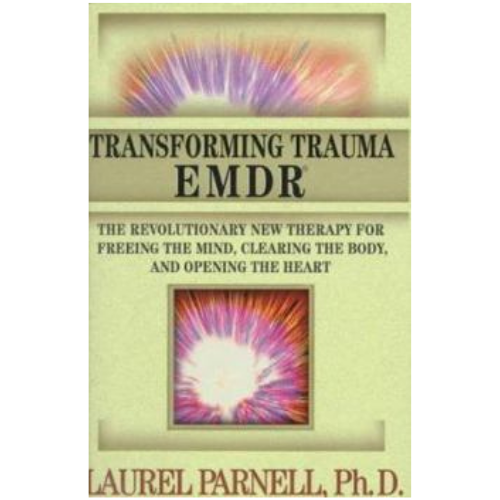
During this period, Laurel published Transforming Trauma: EMDR (1997), a book that reflected what she was seeing in therapy rooms and training spaces as EMDR continued to evolve in real time.
“The feeling in those days was excitement,” Laurel reflects. “There was innovation. There was openness. We trusted therapists to discover what worked.”
Many elements now considered foundational, including interweaves, emerged from these conversations. EMDR was treated as a living method, shaped by what clinicians were actually seeing in the room.
That trust in clinicians would become a hallmark of Laurel’s teaching.
Why Safety Became Central
As EMDR became more widely used, Laurel began to notice something important.
While the standard protocol worked well for single-incident trauma, it often overwhelmed clients with complex developmental trauma. Dissociation appeared unexpectedly. Rigid language and scales pulled clients out of their felt experience and strained the therapeutic relationship.
“You can have a perfect protocol,” Laurel says, “and still lose the person if they don’t feel cared for.”
For her, this was not a technical issue. It was a relational one.
Rather than narrowing EMDR, Laurel expanded it. She emphasized preparation, resourcing, and the therapist-client relationship as foundational to safety. These adaptations were not about diluting EMDR, but about creating enough containment for the nervous system to process without becoming flooded.
This emphasis laid the groundwork for what would later become Attachment-Focused EMDR.
Attachment-Focused EMDR and Developmental Repair
One of Laurel Parnell’s most significant contributions to the field is her articulation of Attachment-Focused EMDR, which recognizes that trauma is not only about what happened, but also about what didn’t.
Many clients carry wounds rooted in absence: the lack of attunement, protection, soothing, and secure attachment. These experiences do not always exist as discrete memories that can be targeted and reprocessed.
Instead, they show up as chronic dysregulation, shame, and difficulty self-soothing.
AF-EMDR addresses this through developmental repair, using imagination, bilateral stimulation, and relational resources to build missing internal structures. When these capacities are in place, trauma processing often becomes faster, gentler, and more sustainable.
“Sometimes,” Laurel notes, “once the repair is there, the trauma work moves much more easily. And sometimes it’s what the person needed most.”
This reframed EMDR as a way not only to resolve the past, but to build what was missing developmentally and within attachment relationships.

A Prolific Voice in the Evolution of EMDR
Over the course of her career, Laurel has authored more EMDR-related books than any other clinician in the field, documenting both the technical evolution of EMDR and its relational, developmental, and integrative dimensions. These books reflect decades of clinical observation, teaching, and careful attention to what supports lasting healing in real therapy rooms.
- Transforming Trauma: EMDR (1997)
- EMDR in the Treatment of Adults Abused as Children (1999)
- A Therapist’s Guide to EMDR (2007)
- Tapping In (2008)
- Attachment-Focused EMDR: Healing Relational Trauma (2013)
- Rewiring the Addicted Brain with EMDR-Based Treatment (2020)
- Releasing What Isn’t Yours: Living From Your True Self Through Multidimensional Integrative Healing (2026, forthcoming)
The Founding of the Parnell Institute

In 2013, Laurel founded the Parnell Institute, creating a dedicated home for AF-EMDR training and the continued evolution of Attachment-Focused EMDR.
What had been developed, tested, and refined over decades of clinical practice and teaching could now be formally held, taught, and carried forward. The Parnell Institute did not mark the beginning of Attachment-Focused EMDR, but rather its maturation, an intentional space for transmitting a relational, safety-centered approach grounded in lived clinical experience.
Through the Parnell Institute, AF-EMDR became not just a body of ideas, but a living lineage.
Clarifying Standards and Creating AF-EMDR Certification
As Attachment-Focused EMDR continued to evolve, Laurel and her colleagues recognized the need for a certification process aligned with the relational, safety-centered principles of AF-EMDR. Over time, mainstream EMDR training pathways have become increasingly rigid and technique-bound, leaving less room for clinical judgment, developmental repair, and therapist attunement.
In response, the Parnell Institute established its own AF-EMDR certification, intentionally separate from EMDRIA, in order to preserve the flexibility, relational depth, and clinician trust that had defined the work from its earliest days.
Teaching Across Cultures: Listening First
Over the years, Laurel has taught EMDR across Europe, Asia, and the Americas. Her books have been translated into multiple languages, and her work has been shaped by profound respect for cultural context.
She observed that many aspects of standard EMDR language do not translate easily across cultures. Naming emotions, identifying beliefs, or assigning numerical ratings can feel confusing or even shaming, depending on cultural norms.
Rather than pathologizing these differences, Laurel adapted.
“What works in one culture doesn’t always work in another,” she explains. “The relationship comes first.”
This commitment to cultural humility reinforced a core principle of her work: EMDR must adapt to the person and the culture, not the other way around.

The Transpersonal Thread
From the beginning, clients working with EMDR often reported experiences that extended beyond traditional psychological frameworks: deep compassion, spiritual imagery, and a sense of freedom from conditioning.
Laurel wrote about these experiences early in her career, carefully describing clients’ reports without imposing interpretation.
“What I’ve always done is describe what I see,” she says. “I don’t tell people what it means.”
Over time, these experiences became widely recognized among EMDR clinicians as natural outcomes of nervous systems no longer organized around trauma.
Loss, Expansion, and What Came Next
In 2020, Laurel experienced profound personal loss when her son was killed. During a period of grief and global isolation, she sought support beyond conventional frameworks, engaging in deep integrative and spiritual healing work.
This did not replace EMDR. It expanded it.

From this experience emerged Multidimensional Integrative Healing, an approach that recognizes multiple dimensions of human experience while remaining grounded in safety, sovereignty, and ethical care. EMDR remains central as an integrative force, helping anchor and process experiences across levels of awareness.
This expanded integrative work is reflected in her forthcoming book, Releasing What Isn’t Yours: Living From Your True Self Through Multidimensional Integrative Healing, to be published in June 2026.
Today, trainings through the Parnell Institute reflect this evolution, emphasizing therapist self-resourcing, grounding, and energetic boundaries as essential components of ethical practice.
A Living Legacy and an Ongoing Invitation
After 30 years, Laurel Parnell’s legacy is not a fixed model or finalized protocol.
It lives in the way clinicians slow down. In the way safety is prioritized. In the way attachment is honored. In the way therapists trust their clinical instincts while remaining grounded in EMDR’s structure.
Through the Parnell Institute, Attachment-Focused EMDR continues to evolve as a living practice shaped by relationship, care, and deep respect for the human nervous system.
This anniversary is not only a moment of reflection. It is a moment of gratitude, and an invitation to continue the work with the same curiosity, humility, and steadiness that have guided it for three decades.
Learn More and Train with the Parnell Institute

Thirty years of teaching EMDR is not just a milestone. It is a reflection of a body of work shaped by listening, relationship, and a deep respect for how healing unfolds in the nervous system.
Through Attachment-Focused EMDR and the work of the Parnell Institute, Laurel Parnell’s approach continues to evolve, supporting clinicians in working with trauma in ways that are safer, more relational, and more attuned to developmental and attachment needs.
For clinicians who feel called to deepen their EMDR practice, upcoming AF-EMDR training opportunities and workshops offered by the Parnell Institute provide opportunities to learn directly from this lineage. These programs are designed to support thoughtful, embodied learning and to help therapists integrate AF-EMDR principles into their clinical work with confidence and care.
To explore upcoming trainings, workshops, and learning opportunities, visit the Parnell Institute’s training calendar and join a community of clinicians committed to relational, safety-centered trauma healing.
View Upcoming Trainings & Workshops
Frequently Asked Questions About Laurel Parnell and Attachment-Focused EMDR
Q: Who is Laurel Parnell?
A: Laurel Parnell, PhD, is a clinical psychologist, EMDR pioneer, and the founder of the Parnell Institute. She is the developer of Attachment-Focused EMDR (AF-EMDR) and has been teaching EMDR to clinicians for over 30 years.
Q: What is Attachment-Focused EMDR (AF-EMDR)?
A: Attachment-Focused EMDR (AF-EMDR) is an evolution of standard EMDR that emphasizes safety, resourcing, and developmental repair. It integrates attachment theory with EMDR to support clients with complex trauma, early relational wounds, and dissociation.
Q: How is AF-EMDR different from standard EMDR?
A: AF-EMDR places greater emphasis on preparation, internal resources, and attachment-based healing before and during trauma processing. This approach helps prevent overwhelm and supports nervous system regulation, especially for clients with developmental trauma.
Q: What is the Parnell Institute?
A: The Parnell Institute, founded by Laurel Parnell in 2013, is a training organization dedicated to teaching Attachment-Focused EMDR and integrative trauma-healing approaches to psychotherapists worldwide.
Q: When did Laurel Parnell begin teaching EMDR?
A: Laurel Parnell began teaching EMDR in 1995 and was among the first clinicians approved to teach EMDR outside of Francine Shapiro’s institute.
Q: Who can benefit from Attachment-Focused EMDR training?
A: Attachment-Focused EMDR training is well-suited for clinicians working with complex trauma, childhood abuse, attachment injuries, dissociation, and clients who feel overwhelmed by standard trauma-processing approaches.
Q: Why is safety such a central focus in AF-EMDR?
A: AF-EMDR prioritizes safety because trauma lives in the nervous system, not just in memory. By strengthening internal resources and attachment capacity, clients can process trauma without becoming flooded or dissociated.
Q: Does AF-EMDR replace standard EMDR?
A: No. AF-EMDR builds upon standard EMDR rather than replacing it. It expands the EMDR model to support clients with complex developmental and relational trauma.
Q: What is Laurel Parnell’s contribution to the field of trauma therapy?
A: Laurel Parnell has advanced EMDR through attachment-focused modifications, developmental repair techniques, expanded resourcing, and a relational, safety-centered approach that has influenced trauma therapy worldwide.
Q: Is Attachment-Focused EMDR evidence-based?
A: Attachment-Focused EMDR is grounded in the evidence-based EMDR framework and informed by attachment theory, neuroscience, and decades of clinical experience. It is widely used by trauma-informed clinicians internationally.

Author: Parnell Institute
The Parnell Institute for EMDR is dedicated to quality education, service and research in the treatment of trauma. We recognizes the importance of treating the whole person—body, mind, heart and spirit—within his or her cultural context.